
Research
Three application domains, one closed-loop architecture.
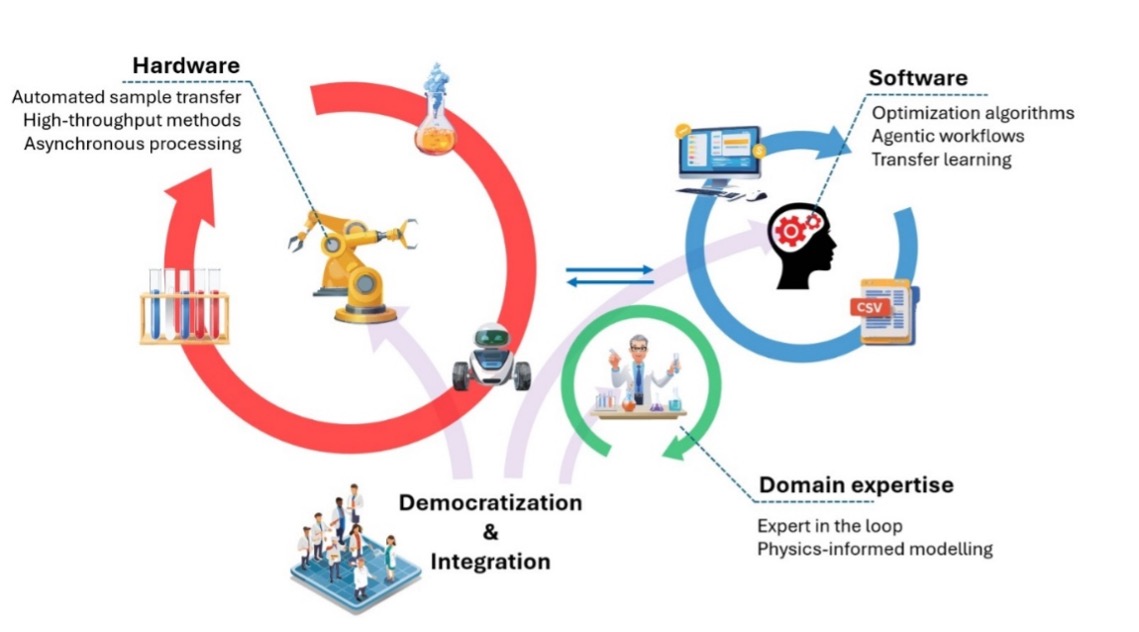
The NGenuity Lab builds autonomous materials-discovery infrastructure: self-driving laboratories that couple robotics, physics-constrained machine learning, and high-throughput experimentation in closed-loop systems that compress the materials development cycle from years to days.
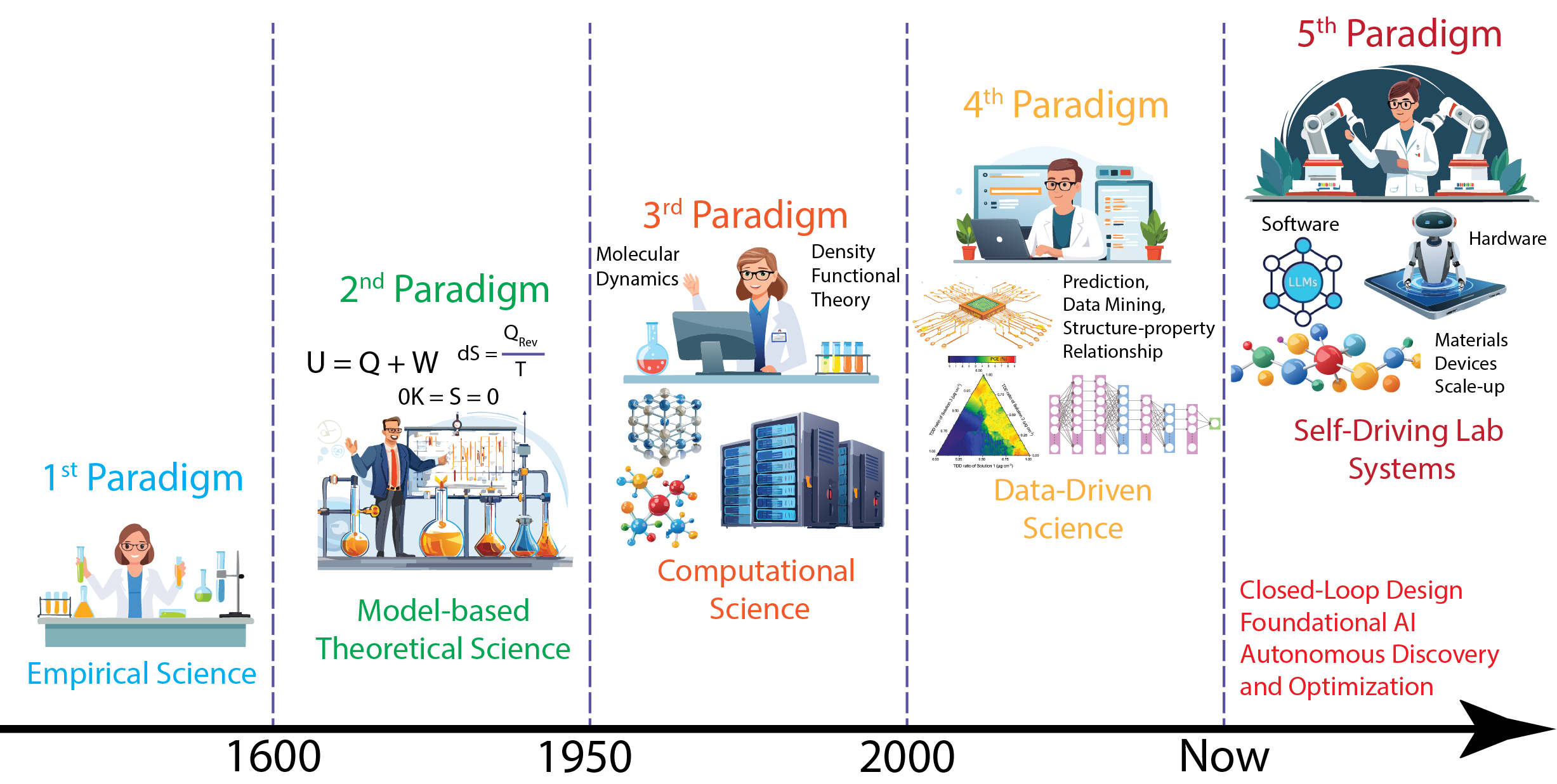
Before this work, the gap between laboratory solar cells and scalable roll-to-roll manufacturing was treated as an intrinsic multi-year device-engineering exercise — the so-called scaling lag that has historically defined the organic and perovskite photovoltaic communities.
Our contribution, developed first in collaboration with CSIRO Manufacturing and extended through the NGenuity Lab at NTU, has been to demonstrate that this gap is in fact a high-dimensional optimisation problem amenable to closed-loop machine learning, and that the same architecture can be embedded directly into manufacturing-scale digital twins. The flagship evidence is the MicroFactory platform (Cell Reports Physical Science 2024), which established a manufacturing-faithful digital twin capable of autonomously optimising a continuous printing process across a 36-parameter space. Its translational reach was demonstrated by the world-first Nature Communications 2024 paper on entirely roll-to-roll fabricated perovskite solar cell modules produced under ambient room conditions.
The MicroFactory paradigm is now the reference design for a small number of self-driving photovoltaic laboratories operating internationally, including ours. The programme is supported by the LuminAI initiative and complementary work on carbon electrodes and non-fullerene acceptors.
- Cell Rep. Phys. Sci. 2024 — A printing-inspired digital twin for closed-loop optimisation of R2R printed PVs
- Nat. Commun. 2024 — First entirely R2R-fabricated perovskite modules under ambient conditions
- Adv. Funct. Mater. 2025 — Biomass-derived furan polymers for hybrid perovskite stability
- Cell Rep. Phys. Sci. 2025 — Strategies to achieve >19% efficiency for organic solar cells
Singapore's 30 by 35 food-security goal — 30% of nutritional needs produced locally by 2035 — is constrained in practice by the unit economics of cultivated meat scaffolding. Scaffolds must simultaneously satisfy organoleptic, nutritional, and manufacturing criteria, and conventional screening cannot keep pace with Singapore's timeline.
We are applying the digital-twin and closed-loop active-learning methodology proven in photovoltaics to scaffold discovery — extending the autonomous materials-acceleration infrastructure into a biologically complex domain. Leonard is also a Principal Investigator on Proteins4Singapore at TUMCREATE, which extends the architecture upstream into protein extraction from microalgae and soybeans.
The deeper change here is conceptual: food materials are now a legitimate application domain for autonomous experimentation, and the methodological innovations required — particularly how ML models handle biological variability and multi-objective targets — feed back into the broader SDL platform.
Only 13.8 of the 62 billion kilograms of e-waste generated globally in 2022 was formally recycled. The photovoltaic and lithium-ion battery sectors alone will generate 80 million tonnes of waste by 2050, representing a USD 15 billion recovery opportunity that is currently squandered because hydrometallurgical process optimisation is slow, manual, and physics-blind. Traditional approaches explore less than 0.1% of the parameter space, and current ML methods routinely propose thermodynamically impossible conditions.
HYDRA (Hydrometallurgical Yield Discovery through Responsive Automation) embeds Pourbaix diagrams, mass balance constraints, and Gibbs–Duhem relationships directly into the neural-network architecture, so that every experiment proposed by the system is chemically feasible by construction rather than by penalty. Paired with scale-invariant dimensionless learning via the Buckingham π theorem, graph neural networks for multi-step extraction sequence planning, and mechanism-aware Bayesian optimisation, the system is designed to compress the optimisation of a five-metal recovery process — silver, copper, aluminium, tin, lead — from six months to seventy-two hours while preserving 98% of lab-scale yields at pilot scale.
Supported by the AI for Science (AI4S) Catalytic Grant, funded by Singapore's National Research Foundation (NRF).
Running alongside the SDL programme is a teaching-impact track on AI in higher education, designed with the same rigour as our materials research. Professor LEODAR — a retrieval-augmented teaching assistant for MS0003 (Data Science & AI) — logged 12,334 interactions from 154 students in a single semester, with 97.1% reporting positive experiences. The evaluation was published in the Journal of Chemical Education (2025).
The underlying NALA Builder technology has been licensed and now powers Project NALA, an institution-wide AI learning-assistant initiative deployed across nine NTU schools with 40+ trained faculty. Coverage in the Straits Times, Times Higher Education, and a BBC StoryWorks / AWS feature has brought the pedagogical approach to international audiences, and the work received the 2024 Global MOOC Alliance Award for AI in Education.
In the press
- More AI chatbots for NTU, NUS to answer questions, boost efficiency and cut errors — The Straits Times
- All in a day's work for AI — from the classroom to the studio — The Straits Times
- When to use an AI professor (and why you might not need one) — Times Higher Education
- Across the spectrum: how AI can benefit us all — BBC StoryWorks
- NTU generative-AI case study — AWS
- AI for university professors, students and grading — Channel News Asia
- 2024 Global MOOC Alliance Awards — winners announcement — Global MOOC Alliance
Active projects
What the lab is working on
- HYDRA — physics-constrained autonomous hydrometallurgy for critical metal recovery
- LuminAI — accelerating ternary organic solar cell innovation with self-driving labs
- Cultivated meat scaffolding — digital twin for engineering organoleptic properties
- Carbon-based printable electrodes — for low-cost, high-performance perovskite solar cells
- Flexible R2R printed solar cells — sustainable, next-generation photovoltaics
- Ternary non-fullerene acceptors — development and optimisation
- Polymer intumescent coatings — for rooftop photovoltaics on legacy roofing
- Flexible OPV interlayer engineering — multi-component organic photovoltaics